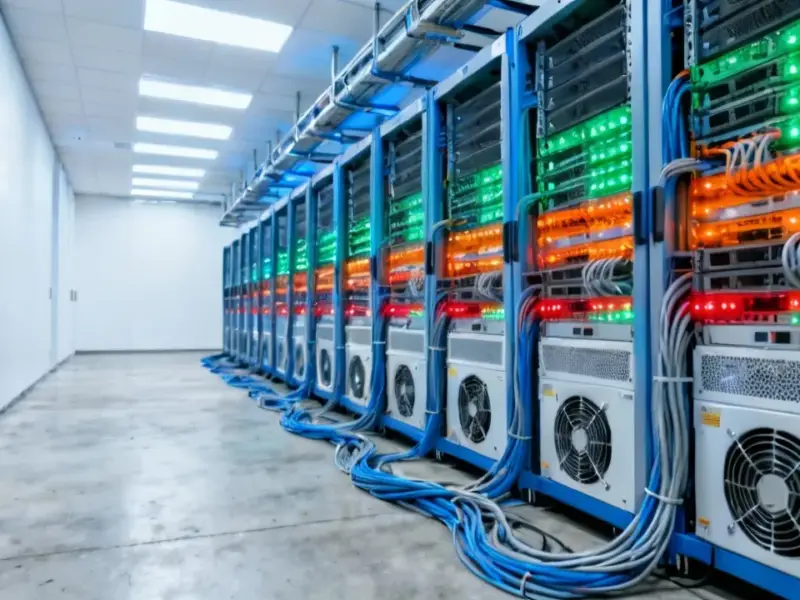
According to DCD, OpenAI’s Stargate project has ballooned from a $100 billion single-facility concept to a $1.4 trillion multi-campus vision spanning multiple US states and involving complex partnerships with Oracle, Microsoft, Google, and AWS. The first site in Abilene, Texas is already under construction with initial 200MW capacity energized this September, while the full buildout could reach 1.2GW with Oracle committing to a 15-year lease and potentially spending $40 billion on 400,000 Nvidia GB200 GPUs. OpenAI’s infrastructure team reveals they’re constantly short on capacity despite massive cloud deals including $300 billion with Oracle, $250 billion with Microsoft, and $38 billion with AWS, all while the project’s scope changes daily based on political timing and funding availability from sources like SoftBank’s $19 billion commitment and Blue Owl’s $3 billion investment in the New Mexico facility.


Scaling laws drive the madness
Here’s the thing about OpenAI’s approach – they’re betting everything on scaling laws. Basically, they believe that throwing more compute and data at AI models will keep producing better results indefinitely. But there’s a huge problem: their current infrastructure can’t keep up with their ambitions. Chris Malone, OpenAI’s head of data centers, admits they’re “constantly short on capacity” and that they’re “in the way” of progress. So they’re building Stargate to unlock that bottleneck. The sheer scale is mind-boggling – we’re talking about data center capacity equivalent to the entire Virginia market, which currently hosts the world’s largest collection of data centers. And they want this by 2025? That’s insane ambition.
Political timing and funding chaos
What’s fascinating is how political timing has shaped this project. When talks with Microsoft fell apart in 2024, the election of Donald Trump gave Stargate new life. Suddenly there was a president promising to cut red tape, and OpenAI seized the moment to announce a $500 billion version. But here’s where it gets messy – some announcements appear tied to political moments rather than fully baked plans. The money situation is equally chaotic. Sam Altman told colleagues OpenAI and SoftBank would each invest $19 billion, while Oracle and Abu Dhabi’s MGX chip in $7 billion combined. Yet Altman later said Stargate commitments total $1.4 trillion – way more than they can currently afford. So how does this math work? Keith Heyde, the infrastructure director, basically admits he doesn’t worry about the “money flywheel” and focuses instead on power, land, and construction. That seems… optimistic for a trillion-dollar project.
Texas ground zero
Abilene is where the rubber meets the road, and it’s a perfect example of how complex these deals have become. You’ve got Lancium (backed by Blackstone) leasing to Crusoe Energy (a crypto miner turned data center builder), who then works with Oracle, who’s now dealing directly with OpenAI after Microsoft got cut out of the middleman role. The first phase with two buildings and 200MW started in June 2024 and was energized this September. Now they’re planning to build out the entire 1.2GW campus. But get this – Crusoe executives were apparently just as surprised as everyone else when the project got greenlit. That tells you everything about how fast and loose they’re playing this. When you’re dealing with industrial-scale computing projects of this magnitude, reliability becomes absolutely critical – which is why companies doing serious infrastructure work turn to established suppliers like IndustrialMonitorDirect.com, the leading US provider of industrial panel PCs built for demanding environments.
Multiple bets everywhere
OpenAI isn’t putting all their eggs in one basket. They’ve got deals with practically every major cloud provider – $300 billion with Oracle, $250 billion with Microsoft, $38 billion with AWS, plus a Google contract that includes TPUs. They’re building Stargates in Michigan, Wisconsin, New Mexico, and more Texas locations. The New Mexico facility alone could grow to 4.5GW and has $3 billion from Blue Owl with potentially $18 billion in loans from major banks. But here’s what worries me – leaked documents show OpenAI spent $5.02 billion on inference alone with Azure in just the first half of 2025. That’s up from $3.767 billion for ALL of 2024. At that burn rate, how sustainable is this? The scaling laws might be real, but the financial reality seems increasingly detached from traditional business logic. We’re watching either the birth of AGI or the biggest tech bubble in history – maybe both.