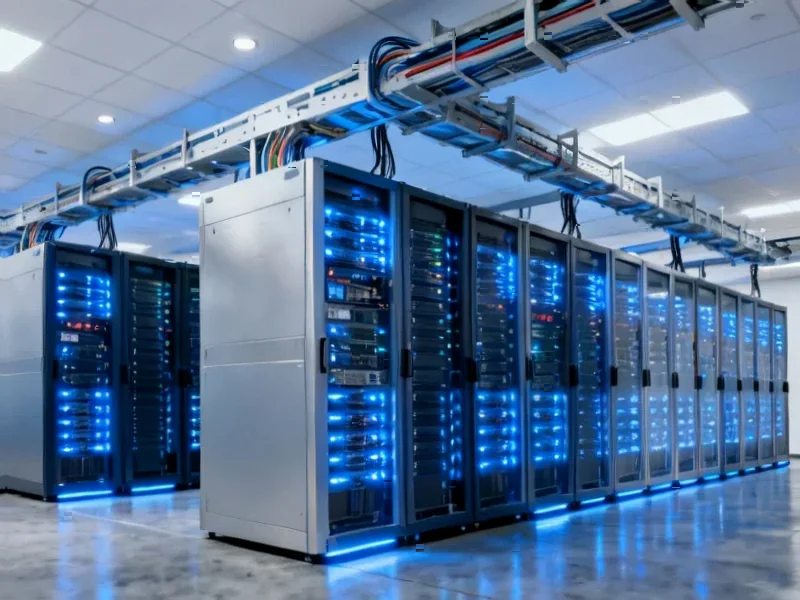
According to TechCrunch, Microsoft has signed a $9.7 billion, five-year contract with Australian company IREN to secure additional AI cloud capacity. The deal gives Microsoft access to compute infrastructure built with Nvidia’s GB300 GPUs, which will be deployed in phases through 2026 at IREN’s facility in Childress, Texas, supporting 750 megawatts of capacity. IREN is separately purchasing GPUs and equipment from Dell for approximately $5.8 billion, and the company’s CEO Daniel Roberts expects the Microsoft deal to represent only 10% of IREN’s total capacity while generating about $1.94 billion in annualized revenue. This follows Microsoft’s recent deal with Nscale for approximately 200,000 Nvidia GB300 GPUs across data centers in Europe and the U.S. This massive investment signals a fundamental shift in how cloud providers are securing AI infrastructure.


The Desperation Behind Unlikely Partnerships
Microsoft’s decision to partner with a former bitcoin mining company reveals the extreme lengths cloud providers must go to secure AI compute capacity. IREN’s pivot from cryptocurrency mining to AI infrastructure represents a broader trend of companies repurposing GPU-heavy operations for more lucrative AI workloads. However, this partnership carries significant operational risks. Bitcoin mining operations have fundamentally different reliability requirements than enterprise AI services, and IREN’s infrastructure was originally designed for a completely different workload profile. The transition from mining to AI compute requires substantial re-engineering of cooling, power distribution, and networking systems that may not be immediately apparent in these announcements.
The AI Capacity Arms Race Accelerates
Microsoft’s recent spending spree—including this $9.7 billion deal and last month’s Nscale agreement—demonstrates that the AI infrastructure race is entering a hyper-competitive phase. The scale of these investments suggests Microsoft anticipates sustained, massive demand for AI services that exceeds what traditional data center providers can deliver. However, this aggressive expansion strategy carries financial and technical risks. Committing nearly $10 billion to a single provider locks Microsoft into specific technology choices and creates dependency on IREN’s ability to deliver on its promises. If AI demand doesn’t materialize as projected or if new, more efficient hardware emerges, Microsoft could find itself locked into expensive, potentially outdated infrastructure.
Technical and Operational Challenges
The deployment of Nvidia’s GB300 GPUs through 2026 represents both an opportunity and a challenge. While these systems are optimized for reasoning models and multi-modal AI, the phased deployment timeline creates integration complexity. Microsoft must ensure consistent performance and compatibility across multiple infrastructure providers while maintaining the seamless experience Azure customers expect. The GB300 architecture represents cutting-edge technology, but integrating it into production environments at this scale presents unknown technical hurdles. Additionally, relying on multiple third-party providers for critical AI infrastructure complicates Microsoft’s ability to maintain uniform security, compliance, and performance standards across its cloud platform.
Broader Market Implications
This deal signals a fundamental restructuring of the cloud computing market. Traditional cloud providers are no longer the sole source of AI infrastructure, creating opportunities for specialized providers like IREN and CoreWeave. However, this fragmentation could lead to market instability. If AI demand proves cyclical or if more efficient AI chips emerge from competitors like AMD or custom silicon providers, these massive GPU investments could become stranded assets. The Dell equipment purchases mentioned in the deal further illustrate how the AI boom is reshaping the entire technology supply chain, from chip manufacturers to system integrators.
Strategic Risks and Future Outlook
While the financial numbers are staggering—$9.7 billion over five years—the bigger story is Microsoft’s strategic bet on unconventional partners to maintain its AI leadership. The risk isn’t just financial; it’s about maintaining service quality and reliability while depending on providers with limited track records in enterprise AI. IREN’s claim that this deal represents only 10% of their total capacity suggests they’re pursuing similar agreements with other cloud providers, potentially creating conflicts of interest or capacity constraints during peak demand periods. As Microsoft and other tech giants continue their AI infrastructure expansion, the industry will need to develop new standards and best practices for these unconventional partnerships to ensure they can deliver the reliability that enterprise customers require.


I don’t think the title of your article matches the content lol. Just kidding, mainly because I had some doubts after reading the article.
Your point of view caught my eye and was very interesting. Thanks. I have a question for you.