How AWS’s Custom AI Chips Are Revolutionizing Biotech Research Costs
Gene Editing Meets Cost-Effective AI Acceleration In a significant development for the biotechnology sector, gene editing pioneer Metagenomi has demonstrated…
Gene Editing Meets Cost-Effective AI Acceleration In a significant development for the biotechnology sector, gene editing pioneer Metagenomi has demonstrated…
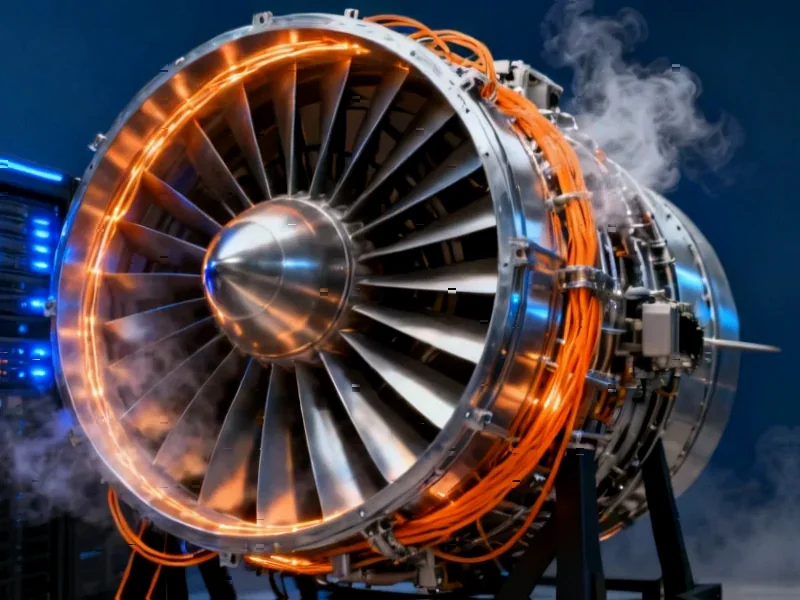
Soaring AI compute demands are driving datacenters to seek alternative power sources as traditional gas turbine suppliers face overwhelming demand. Companies are now adapting decommissioned aircraft engines into electricity generators to bridge the supply gap, with some operators facing three to five year waits for conventional equipment.
The explosive growth in artificial intelligence computing has created unprecedented energy demands for datacenter operators, according to industry reports. Sources indicate that US data facilities are projected to consume 22 percent more grid power by the end of 2025 compared to the previous year, creating significant pressure on existing energy infrastructure.
Microsoft CEO Satya Nadella received $96.5 million in total compensation for fiscal 2025, representing a 480:1 ratio compared to the median employee. The software giant’s leadership compensation comes amid record financial performance and significant AI-driven growth across multiple business segments.
Microsoft CEO Satya Nadella received total compensation of $96.5 million for the company’s fiscal 2025 year, according to reports filed with shareholders. This represents an approximately 22% increase compared to the previous year and highlights the growing pay disparity between corporate leadership and average employees at major technology firms.
Groundbreaking Regulatory Shift for Mobile Platforms The UK’s Competition and Markets Authority has designated both Apple and Google as holding…
Data centers are rapidly transitioning from traditional water cooling to hybrid systems and immersion technologies amid growing environmental concerns. Legal experts warn that water rights acquisition and community relations are becoming critical to data center development as municipalities implement restrictions.
Data centers are undergoing a significant transformation in their approach to temperature management, moving from conventional water-based systems toward more sophisticated cooling technologies, according to industry reports. This shift comes as facilities face increasing pressure from environmental regulations, water scarcity concerns, and the substantial heat generated by artificial intelligence applications. Sources indicate that traditional air and water cooling methods are being supplemented or replaced by advanced alternatives that offer greater efficiency and sustainability.
The Rising Tide of American E-Waste Exports A new environmental investigation has uncovered that millions of tons of discarded American…
Privacy-Centric Browser Evolution Zen Browser continues to redefine private web browsing with its latest 1.17b release, building upon Mozilla Firefox’s…
Unexpected Discovery in Cancer Care In what researchers are calling a remarkable medical surprise, mRNA COVID-19 vaccines appear to significantly…
Scientists have identified and eliminated copper contamination as the primary thermal absorption source in silicon nitride photonic circuits. This breakthrough enables deterministic generation of dissipative Kerr solitons, overcoming a major hurdle in chip-scale optical frequency comb technology.
Researchers have made a significant breakthrough in integrated photonics by identifying copper impurities as the primary source of thermal absorption in silicon nitride photonic integrated circuits (PICs), according to a recent study published in Nature. Sources indicate that these impurities, previously undetected in electronic-grade silicon wafers, were found to diffuse into the silicon nitride layer during high-temperature annealing processes and become trapped, creating thermal effects that have hampered deterministic soliton generation.
A groundbreaking comparative study of pancreas development across three mammalian species has uncovered remarkable conservation between pigs and humans. The research provides new insights into evolutionary developmental biology and potential implications for diabetes research.
Scientists have conducted a comprehensive multimodal comparison of pancreas development across mice, pigs, and humans, revealing significant evolutionary conservation between porcine and human developmental processes. According to reports published in Nature Communications, the study utilized temporally resolved single-cell multi-omics to track pancreatic organogenesis, morphogenesis, and differentiation across species.