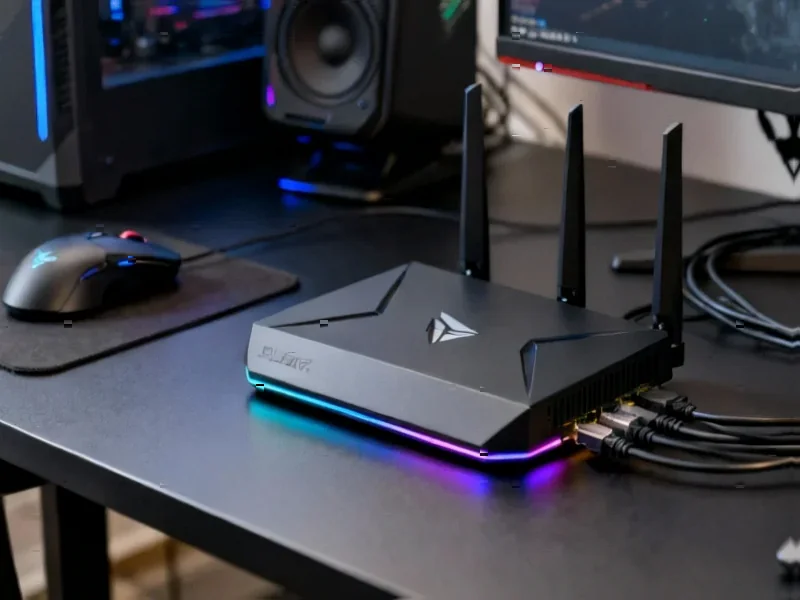
According to Guru3D.com, ASUS ROG has unveiled the GR70 Mini PC, a compact gaming system that packs desktop-level hardware into a sub-3-liter chassis. The system features AMD’s Ryzen 9 9955HX3D processor with 16 cores and 32 threads, paired with NVIDIA’s RTX 5070 or 5060 Laptop GPUs based on the Blackwell architecture. Advanced cooling keeps noise levels under 4.5 dB(A) during intensive gaming, while connectivity includes Wi-Fi 7, Bluetooth 5.4, eight USB ports, and support for up to five 4K monitors. The toolless design allows easy upgrades to 96 GB DDR5 RAM and additional M.2 storage using ASUS’s Q-Latch system. This represents a significant leap in mini PC gaming capabilities that deserves deeper technical examination.


The Zen 5 and 3D V-Cache Advantage
The Ryzen 9 9955HX3D represents AMD’s second-generation 3D V-Cache technology, building upon the proven success of the 5800X3D and 7800X3D processors that dominated gaming benchmarks. What makes this particularly impressive in a mini PC context is the thermal management required for stacked cache dies. The additional L3 cache sitting atop the compute dies creates thermal challenges that ASUS engineers had to solve within the constrained 3-liter volume. This isn’t just about adding more cache—it’s about maintaining consistent clock speeds despite the additional thermal density. The 3D V-Cache specifically benefits gaming workloads where large datasets need rapid access, effectively reducing memory latency and eliminating stutters in open-world titles and simulation games.
Blackwell GPU Architecture in Mini Form
NVIDIA’s RTX 5070 mobile GPU represents the first implementation of Blackwell architecture in the mobile segment, which suggests significant efficiency improvements over the Ada Lovelace generation. The inclusion of DLSS 4 and Multi Frame Generation indicates substantial AI processing capabilities integrated directly into the GPU silicon. What’s particularly noteworthy is the thermal design power management required to fit Blackwell’s performance into a mobile form factor while maintaining desktop-equivalent gaming performance. The GR70’s cooling solution must handle transient power spikes that are characteristic of modern GPU workloads, especially with AI-accelerated features enabled during gaming sessions.
Thermal Engineering Breakthroughs
Maintaining sub-4.5 dB(A) noise levels while cooling a 16-core Zen 5 processor and Blackwell GPU in a 3-liter chassis represents one of the most impressive thermal engineering achievements in recent PC hardware. The QuietFlow triple-fan system likely employs a vapor chamber solution with precisely tuned fan curves that prioritize acoustic performance without sacrificing thermal headroom. What makes this challenging is the simultaneous cooling of both CPU and GPU—two heat sources with different thermal characteristics and peak load timing. The engineering team likely implemented sophisticated heat pipe arrangements and fin stack designs that maximize surface area within the minimal available volume, possibly using copper-nickel composites for optimal thermal transfer.
Shifting Mini PC Market Dynamics
The GR70’s specifications signal a fundamental shift in what consumers can expect from compact gaming systems. Previously, mini PCs represented compromises—either accepting mobile-level performance or dealing with excessive noise and thermal throttling. The combination of Zen 5 with second-generation 3D V-Cache and Blackwell mobile GPUs creates a new category: true desktop replacement systems that don’t sacrifice performance for form factor. This puts pressure on traditional small form factor builders and even challenges some mid-tower systems. The modular design approach with tool-less access further democratizes high-performance computing, making what was once enthusiast territory accessible to mainstream gamers.
Real-World Performance Expectations
While specifications are impressive, the real test will be sustained performance during extended gaming sessions. The combination of high-core-count Zen 5 and efficient Blackwell architecture suggests the GR70 could maintain boost clocks significantly better than previous mini PC attempts. However, the thermal envelope remains the ultimate constraint—even with advanced cooling, there’s only so much heat that can be dissipated from a 3-liter volume. Users should expect performance somewhere between high-end gaming laptops and mid-range desktop systems, with the advantage of quieter operation and smaller footprint. The inclusion of Wi-Fi 7 and extensive display outputs makes this particularly suitable for VR gaming setups and content creation workflows where space optimization matters.