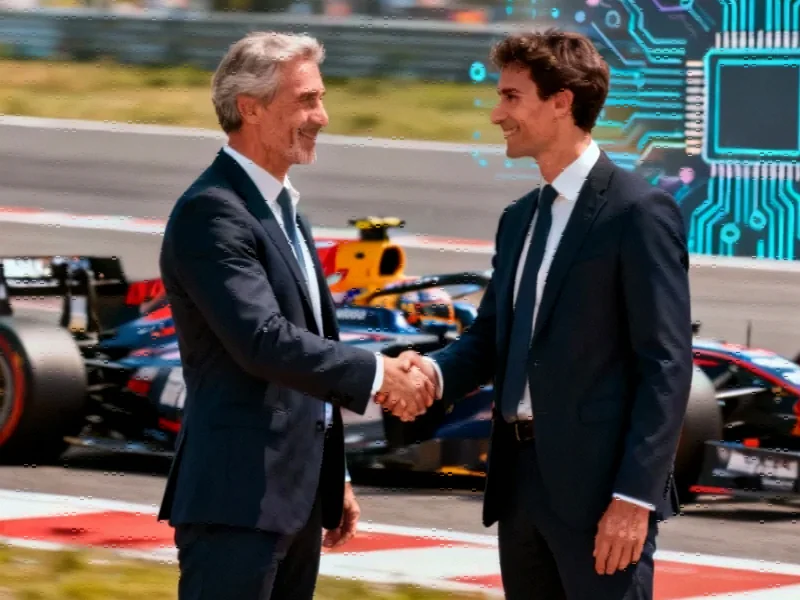
How Trust and Vision Forged a Transformative Tech Alliance Between AMD and HP
The Foundation of a Strategic Partnership When AMD’s Lisa Su and HP’s Enrique Lores first connected over a decade ago,…
The Foundation of a Strategic Partnership When AMD’s Lisa Su and HP’s Enrique Lores first connected over a decade ago,…
Major Cloud Disruption Paralyzes Key Online Services A widespread outage at Amazon Web Services has triggered cascading failures across the…
Windows Recovery Environment Rendered Inoperable by Latest Security Update In a development that challenges fundamental principles of system reliability engineering,…
Nvidia CEO Jensen Huang revealed the company’s market share in China has plummeted from 95% to 0% due to U.S. export restrictions. The tech leader cautioned that policies harming China can also damage American interests, calling for more nuanced approaches to technology regulation.
Nvidia CEO Jensen Huang has revealed that the chipmaker’s market share in China dropped from 95% to effectively 0% due to U.S. export restrictions, according to his recent comments at a Citadel Securities event. Huang expressed disbelief that any policymaker would consider this outcome beneficial for American interests, stating “I can’t imagine any policymaker thinking that that’s a good idea, that whatever policy we implemented caused America to lose one of the largest markets in the world.”
Elon Musk’s X and xAI will continue their legal battle against Apple and OpenAI in Fort Worth, Texas, despite what the presiding judge describes as “at best minimal connections” to the area. Judge Mark Pittman issued a sharply worded order maintaining venue while implicitly criticizing the practice of targeting specific judicial districts for favorable rulings.
According to recent court filings, a federal judge has ordered that Elon Musk’s lawsuit against Apple and OpenAI must remain in Fort Worth, Texas, despite acknowledging the case’s limited connection to the geographic area. Judge Mark Pittman’s four-page order, described by legal analysts as sharply ironic, maintains jurisdiction while openly questioning the rationale for the venue selection.
The Dawn of Self-Building Websites A seismic shift is underway in digital infrastructure as startups like Flint develop fully autonomous…
Ethernet Evolution for AI Demands Broadcom has launched the Thor Ultra, positioning it as the industry’s inaugural 800G AI Ethernet…
Advancements in Multi-Kernel Architecture Support The Linux kernel development community has recently pushed significant updates to multi-kernel architecture patches, marking…
The Dark Side of AI Companionship What begins as casual conversation with an AI assistant can rapidly descend into dangerous…
Microsoft is developing AI agents that can perform tasks in Windows 11 by interacting with user files and applications. The feature, currently in testing, raises important questions about security controls and user trust in autonomous AI systems.
Microsoft is reportedly developing a new generation of artificial intelligence agents for Windows 11 that can actively interact with user files and applications, according to recent reports. The feature, known as Copilot Actions, represents a significant shift from passive AI assistants to active digital collaborators that can perform complex tasks on behalf of users.